

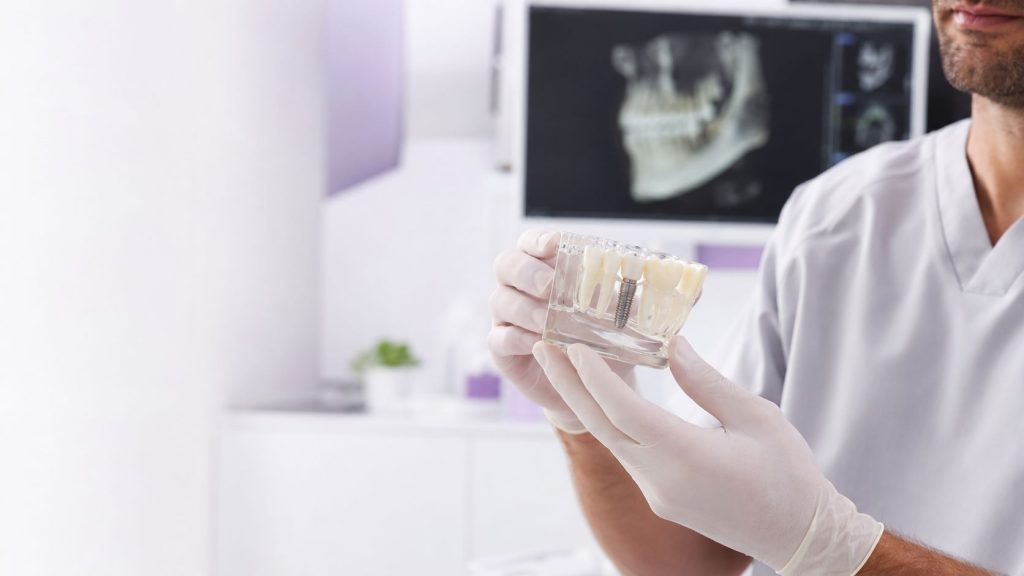
The expression "dental implants in one day" often creates the impression that the patient receives implants and completely finished, definitive prosthetic work during one visit. In practice, this name most often describes an accelerated implantology protocol in which the implant is placed, and the temporary fixed tooth or bridge is attached on the same day or in a very short time.
This approach can significantly reduce the time spent without teeth and the number of procedures, but it is intended for carefully selected patients. Success depends on bone quantity and quality, gum health, tooth position, bite, general health, and the stability achieved by the implant during placement. Consequently, the decision to use this protocol follows a detailed diagnostic assessment, while final confirmation often occurs only during the procedure itself.
What does "same-day implant" actually mean?
In implant therapy, it is important to distinguish between the time of implant placement and the time of placing the tooth restoration onto the implant. Immediate placement means the implant is inserted into the socket immediately after tooth extraction. Immediate restoration or loading means that a temporary crown or bridge is placed on the implant on the same day—or within a period of up to one week.
These two procedures can be combined, though they do not have to be. Sometimes, an implant is placed immediately after extraction and left to heal without a crown. In other cases, the implant is placed into bone that has already healed, and a temporary prosthetic restoration is fitted on the same day. Consequently, the term patients hear in advertisements can encompass various clinical situations; therefore, it is important to clearly explain what will be done during the first visit before treatment begins.
Does the patient receive temporary or permanent teeth?
In most cases, the patient receives a temporary fixed tooth or bridge on the same day. Its purpose is to restore the appearance of the smile, facilitate speech, and allow for limited function while the implant integrates with the bone and the gums contour around the future prosthetic restoration.
Privremeni zub izgleda prirodno, ali se planira tako da zaštiti implantat od prevelikog pritiska. Kod pojedinačnog implantata, posebno u prednjoj regiji, krunica se često oblikuje bez direktnog kontakta sa zubima suprotne vilice. Kod većih fiksnih radova, sile se raspoređuju preko više implantata, uz obavezne upute o mekšoj ishrani tokom početnog perioda zarastanja.
The definitive crown or bridge is fabricated once stable osseointegration—the biological bonding of the implant to the bone—is confirmed and the soft tissues have achieved a stable shape. This period lasts several months and varies from patient to patient. Teeth can be placed on the same day, but the overall treatment continues through the healing and follow-up phases, culminating in the fabrication of the final restoration.
Who can be a candidate for same-day dental implants?
Age is not the sole criterion for this procedure. The patient's health status and local conditions at the implant site are far more important. A good candidate typically has sufficient bone to allow the implant to be placed in the correct three-dimensional position and to achieve firm initial stability immediately. Healthy or well-controlled gums, good oral hygiene, and a favorable relationship between the teeth and jaws are also important factors.
Assessments are also made regarding general health, chronic conditions, current medications, smoking habits, and any circumstances that might affect healing. Active periodontal disease requires treatment and the control of inflammation first. Intense tooth grinding or clenching, an unfavorable bite, and habits that exert significant pressure can increase mechanical risk during the critical phase of implant-to-bone integration.
The condition of the bone following tooth extraction is of particular importance. An ideal scenario involves preserved socket walls and sufficient bone beyond the root area to ensure stable implant anchorage. While a thin or partially damaged outer bone wall can sometimes be restored using bone and soft-tissue grafts, the procedure becomes more complex and the risk assessment more demanding in such cases.
The presence of chronic inflammation around the root apex does not always rule out immediate implant placement. Professional guidelines indicate that this approach may be considered when there is no fistula, when infected tissue can be completely removed, and when sufficient healthy bone remains after debridement to ensure implant stability. Acute infection, a large bone defect, or the inability to achieve complete debridement may necessitate a delayed treatment protocol.
Why are the examination and 3D scan important?
Same-day implant planning begins with a clinical examination, an analysis of the gums and bite, and radiological diagnostics. A CBCT scan provides a three-dimensional view of bone width and height, the position of anatomical structures, and the condition of the outer bone wall. Based on this data, an assessment is made as to whether the implant can be placed in a position that simultaneously meets surgical, functional, and aesthetic requirements.
Digital planning can assist in determining implant positioning and allow for the pre-fabrication of a temporary crown or bridge. However, the scan and software-based plan represent only an initial assessment. Following tooth extraction, the clinician must verify the actual condition of the bone and measure the implant's primary stability. Only then is a final decision made regarding the safety of immediately attaching the temporary restoration.
What does the process look like?
If the tooth is still present, the procedure begins with its careful extraction—performed in a way that minimizes trauma—to preserve the bone and gums. The socket is thoroughly cleaned, and the implant is placed in a pre-planned position. If a gap exists between the implant and the outer bone wall, bone substitute material may be added. In cases of thin gums or heightened aesthetic risk, soft tissue augmentation may also be required.
Following placement, the stability of the implant is assessed. If the values are favorable and the prosthetic restoration can be contoured without risky occlusal contacts, a temporary crown or bridge is placed. The temporary restoration must be precisely fitted, smooth, and shaped to support the gums without exerting excessive pressure.
When restoring an entire jaw, a temporary fixed bridge can be placed on multiple implants on the same day, provided that their number, arrangement, and stability allow for the safe distribution of forces. The treatment plan for such a procedure differs from that for replacing a single tooth and requires a separate assessment of the bone, bite, and the design of the final restoration.
What if the implant is not stable enough during the procedure?
Primary stability refers to the mechanical strength of the implant immediately after placement. It is one of the key prerequisites for placing a temporary tooth on the same day. If the implant does not achieve the necessary stability, premature loading can interfere with its integration with the bone.
In such a situation, the implant can be left to heal without loading, using a different type of temporary tooth. If the implant cannot be placed correctly, the socket can be preserved with bone graft material, and placement planned for after healing. Such a contingency plan is part of responsible treatment and should be explained to the patient before the procedure begins.
What are the advantages and what are the limitations?
The primary advantages include a shorter overall treatment duration, fewer surgical interventions, and the possibility of avoiding any period without a fixed tooth. In the aesthetic zone, a temporary crown can help preserve gum contours, while in full-arch rehabilitation, a fixed temporary bridge can significantly facilitate speech, daily functioning, and adaptation to the new smile.
This protocol is technically demanding and sensitive to detail. Potential complications include infection, loss of stability or the implant, gum recession, aesthetic irregularities, and loosening or damage to the temporary restoration. Clinical data indicate a high success rate in carefully selected cases, noting that the majority of early failures occur during the initial months of healing.
Speed is therefore valuable when biological and mechanical conditions support such a plan. The goal of therapy remains a long-term stable implant, healthy surrounding tissues, and a functional prosthetic restoration that can be properly maintained.
When is the classic protocol a safer choice?
Delayed implant placement or delayed loading is often recommended when there is insufficient bone for initial stability, the outer bone wall is significantly damaged, extensive bone augmentation is required, or active gum disease is present. The conventional protocol may also be preferable in cases of unfavorable bite, severe bruxism, poor oral hygiene, or health conditions that slow down healing.
Such a plan allows the bone and soft tissues time to stabilize before the next phase of therapy. The overall process takes longer, but it can reduce biological and mechanical risks in more complex cases. Therefore, the choice of protocol is based on an assessment of safety and the predictability of outcomes for the specific patient.
Healing period and the importance of follow-up appointments
After the temporary teeth are placed, the patient receives instructions regarding oral hygiene, diet, and the load placed on the prosthetic restoration. During the initial period, a softer diet is usually recommended, and patients are advised to avoid biting directly into hard foods with the temporary tooth. Follow-up appointments serve to monitor gum healing, implant stability, and the condition of the temporary restoration.
Regular cleaning of the area around the implant is important from day one, using techniques and aids adapted to the recovery phase. Once osseointegration is complete, the implants and surrounding tissues are evaluated, precise digital or conventional impressions are taken, and the definitive crown or bridge is fabricated.
Individual assessment is more important than speed.
"Same-day" dental implants can be a safe and predictable solution for selected patients; however, the term "same-day" refers to the initial surgical and temporary prosthetic phase, not the completion of the entire process. A high-quality outcome requires precise diagnostics, expertise in both the surgical and prosthetic aspects of the treatment, careful monitoring of the healing process, and patient cooperation.
At the Bandić Polyclinic, the assessment of candidates for implant therapy is based on a clinical examination, radiological analysis, and an individualized treatment plan. When conditions are favorable, an accelerated protocol can shorten the path to a fixed smile. When risks are higher, the conventional protocol provides a safer framework for a stable, long-term result.


 English
  Bosnian